
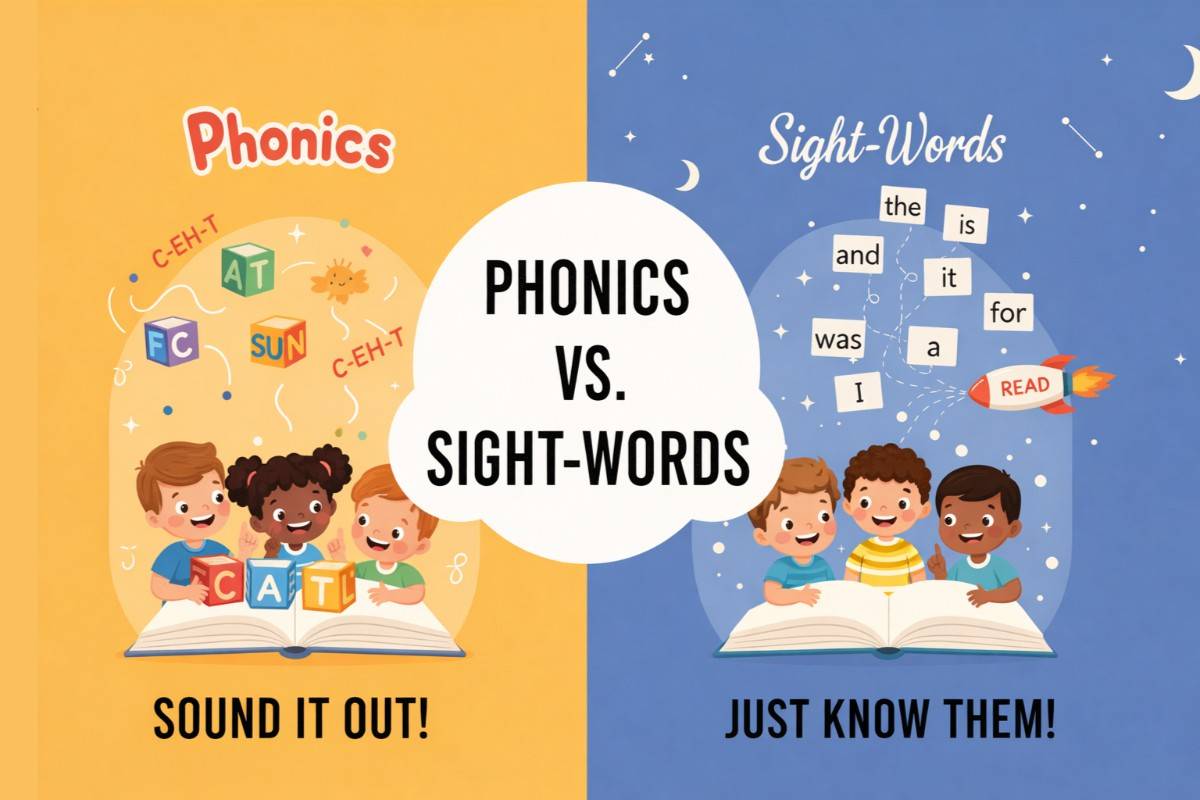
Reading can be a challenging process for some children, and it involves mastery of various skills. Early reading development can be mastered by two fundamental elements, including Phonics and Sight Words.
Today, let us understand the Phonics vs Sight-Words to help your child learning to read and speak with ease. After all, a sturdy foundation in Sight Words and Phonics Sounds can lead to reading, speaking, and writing success.
And, what can be the best way to get acquainted with this concept than starting with a real-life event?
A few days ago, HOSS conducted a workshop for parents on how to teach phonics to young learners. I was giving the useful tips to parents, when a mother raised her hand and questioned-" I make my daughter learn 3-letter words spellings every day, but after 5-6 days she keeps forgetting half of the spellings, what is the issue with her?"
I smiled and told her that spellings are not to be remembered, it follows simple rules. Once your daughter acquires the knowledge of these rules, she will be reading not just 3-letter but 4,5 and 6-letter words as well and that too on her own! This set of rules is nothing but a study of Phonics. I told her to let her daughter attend HOSS Phonics classes for a few days to witness for herself the magic of Phonics.
At HOSS (House of Soft Skills), with our Phonics and Personality Development Program (PPD), we help children between the age group of four and six years master the Phonics to make them read, speak, and write properly. We give importance to personalized attention and encourage every child to express themselves freely in our micro batches (max up to three kids).
Now, if you have been wondering what is Phonics vs Sight-Words, and the importance of Phonics Sounds in Early Reading, then let us help you:
What Are Sight Words?
Let us first answer this question: What Are Sight Words? Sight words, also recognized as the high-frequency words, are the words that appear frequently in our writing and reading. These words should be recognized and recalled quickly on sight, and there is no need to sound them out. For example, “is,” “the,” “it,” and many more.
Some sight words can be sounded out easily by using the Phonics rules, but many cannot be decoded. Like phonics, the sight words also play a crucial role in developing reading, speaking, and writing fluency in young learners. These words help them understand the meaning of the content rather than making them spend time decoding each word.
What are Phonics Sounds?
Now, let us understand - What are Phonics Sounds? Phonics teaches children to read, speak, and write by decoding words through the letter-sound relationship. Every letter in the alphabet has a distinctive Phonics sound, and when they are blended with different Phonics letters, they create different sounds.
At House of Soft Skills (HOSS), we believe that Phonics is essential as this helps build accuracy in reading and spelling. Thus, help children master the art of reading, speaking, and writing with many engaging and easy Phonics activities. After all, we help children embrace the learning journey with confidence and ease!
Phonics vs Sight-Words: The Key Differences Between Phonics Sounds and Sight Words
As we have understood what Sight Words and Phonics sounds are, let us now come to the distinguished traits between them with our comprehensive details on Phonics vs Sight-Words. The purpose of the sight words is to improve and enhance reading speed and fluency. At the same time, the purpose of the Phonics sounds is to build and develop accuracy in writing and reading.
Now, if you think which approach is better, then there is a need to follow the combined approach.
1. Phonics First: Teaching phonics initially allows children to break down most words, including the complex ones they encounter.
2. Sight Words for Speed: The Sight words help children read faster without stopping to sound out every single word.
3. Decodable Sight Words: Many sight words can be decoded with the help of Phonics sounds. It is more effective than rote memorization.
Understanding Phonics Sounds from A to Z
When teaching the Phonics sounds from A to Z, children must learn the “letter-sound correspondence.” For example, the letter “a” creates the /a/ sound as in apple, and the letter “b” creates the /b/ sound as in bat.
At HOSS, we think that teaching Phonics is not about memorizing sounds, but it is all about applying certain rules that govern the way the sounds work, combined to form words. Let’s see how Ahaana who is 5-year-old balances both, let’s look at a "Level 1" sentence that she encountered in a HOSS Phonics session:
The Sentence:
"She can hop to the red box."
Here is the step-by-step "brain process" of a 5-year-old reading this:
1. The Sight Words (The Shortcuts)
The child encounters "She," "to," and "the." * The Action: They do not stop to sound these out. Their brain recognizes the shape of the word instantly.
- Why: If they tried to use phonics for "the" (/t/ /h/ /e/), it wouldn't sound right. These are often "tricky words" that appear so often they must be memorized to keep the reading smooth and fast.
2. The Phonics Words (The Decoding)
The child encounters "can," "hop," "red," and "box."
- The Action: The child points to each letter and "taps" the sounds out:
- c - a - n = can
- h - o - p = hop
- r - e - d = red
- b - o - x = box
- Why: These are "CVC" words (Consonant-Vowel-Consonant). They follow the rules. By using phonics, the child isn't guessing; they are logically constructing the word from its parts.
The Importance of Phonics Sounds in Early Reading
It is essential to encourage every child to learn reading, speaking, and writing with the help of Phonics sounds at an early age. It helps build a robust foundation for their academic excellence and makes them a future-ready personality. The importance of Phonics Sounds in Early Reading; thus, cannot be denied. Without the sturdy foundation and understanding of the Phonics sounds, the children may face struggles to read, speak, and write.
Learning Phonics at an early age makes the child a confident reader. It also strengthens a profound understanding of language and literacy, which helps set the stage for advanced reading, speaking, and writing skills.
Helping Children Read, Speak, and Write with Confidence | HOSS
In the end, we must say that both the sight words and Phonics sounds play an essential role in early reading instruction. It is also essential to understand Phonics vs Sight-Words. Phonics sounds help children decode words easily, while sight words help children improve their reading fluency.
At HOSS, with our PPD Program, we aim to build a sturdy foundation for the child by making them learn Phonics sounds easily with engaging activities. However, at HOSS, we believe in the holistic growth and development of children with soft skills and personality development courses. Our other programs, like the SSD Program, EPD Program, and Logic and Data – The Math Foundation, are valuable in achieving this aim. We hope our comprehensive guide on the Phonics vs Sight-Words is helpful to you! Book the demo session now!
Frequently Asked Questions (FAQs)
Q1. How to learn phonics?
A1. Learning Phonics involve a systematic approach to connect sounds with letters. At HOSS, with our PPD program, we help children master this art with many easy and engaging Phonics activities. These include Storytelling and Reading, Games, Rhyme-time Games, Missing Letters, and many more.
Q2. What is blending in Phonics?
A2. Blending in phonics is the essential reading skill of merging individual letter sounds (phonemes) together in sequence to form a complete word, such as joining /b/-/a/-/t/ to say "bat". It is a core decoding strategy. It allows children to read unfamiliar words by sounding them out from left to right, rather than memorizing them.
Q3. Why is Phonics important?
A3. Phonics is crucial. It acts as the primary foundation for reading, writing, and spelling by teaching the connection between letters (graphemes) and sounds (phonemes).
Q4. What are phonics skills?
A4. The five core skills of phonics are learning letter sounds, letter formation, blending (for reading), segmenting (identifying sounds for writing), and tricky words.
Q5. What are sight words?
A5. Sight words are common, high-frequency words. These are taught to the young readers to recognize instantly by sight, without needing to sound them out. For example, “you,” “it,” “and,” and others.