
If you have worked in a corporate environment, you must have heard about Soft Skill courses for employees. But wait, does it make sense to consider soft skills courses for kids? If yes, at what age? Will they be helpful or a waste of your time and money?
We will explain all these and the top 5 soft skills to learn, but before that, let us dive deep into
What are Soft Skills?
Soft skills are the little things that people do every day to make their lives better. It includes everything from managing time wisely and efficiently, working well in teams or alone, and communicating effectively; all these little actions contribute towards growth, development and achieving the goal.
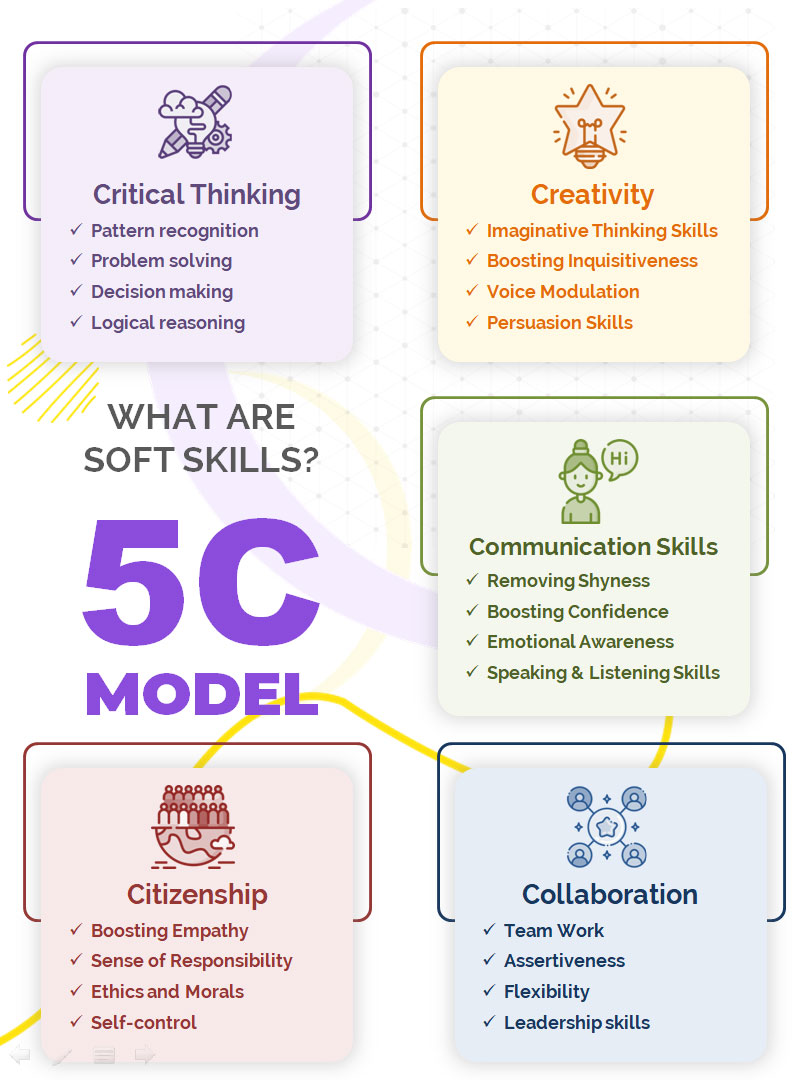
5 C model of Soft Skills: What are the Various Soft Skills for Students?
The Five C's include critical thinking, creative thinking, communication, collaboration, and citizenship. Students will be equipped with the knowledge and skills they need to succeed in life through the application of these concepts across academic disciplines.
The Set of Skills Most Required to Succeed in the 21st Century
Now, since we have understood what are Soft Skills, let us gain profound insights into the importance of Soft Skills.
-
Critical Thinking
Critical thinking is a skill that allows you to make informed and logical decisions to the best of your ability.
It is a helpful tool for children to use when they are making decisions. Critical thinking skills help them be more informed and able to critically analyze the information that they receive, which can lead to better problem-solving activities.
-
Creativity
"Creativity is seeing what others see and thinking what no one else ever thought." - Albert Einstein.
Creativity is one of the soft skills for students and is supposed to help develop innovative solutions to problems. It requires an openness to innovation and mental flexibility. Creativity is the key to success for any child. Soft skills like creativity can be developed at an early age, which will set them up with a head start in life and help build imagination and original thinking.
-
Communication Skills
“Of all the life skills available to us, communication is perhaps the most empowering.” – Bret Morrison.
The other critical soft skills among the top 5 soft skills to learn are communication skills.
Communication skills are the tools you use to clearly and effectively converse with others, set expectations, and collaborate on projects. Good communication skills are essential to allow others and yourself to understand information more accurately and quickly.
Communication skills are essential for kids to develop and grow. These are the types of soft skills that help them learn how to communicate with others effectively, express their feelings in a way that is appropriate and helpful (and not hurtful), and resolve disputes peacefully, when possible, all of which will make life more enjoyable both at home and outside it.
-
Collaboration
I believe you learn social skills by mixing with people - Joe Morgan
Collaborating with others is one way to solve a problem or achieve an objective. Not only does it help you work faster, but it also increases the chance for success by bringing different perspectives on what needs to be done to accomplish your goal.
Read more about: Eight Most Important Soft Skills That Improve Your Child’s Behavior
Collaborate with your child to improve various types of soft skills in a variety of areas, such as communication and organization. These will help them be more successful at school or work. Collaborative play is a fun way to help your child learn and develop their social skills. It gives them opportunities they may not encounter otherwise, like collaborating with other children or working on projects together in groups.
-
Citizenship
With citizenship skills, you can be more likely to succeed in life and contribute positively to your community.
We all know the importance of good citizenship in our children. Good, clean and healthy living is an integral part of raising a well-informed young adult with global perspectives who can take on any problem around them.
The best way to strengthen the resolve of our youth is through soft skills for students. These can be things like empathy, social awareness and communication, all qualities that will help them become productive members not only in their communities but also in global society as well.
Related Blog : Soft Skills + Technical Skills
Research has shown time and time again that infants who receive high-quality child care and early education programs do better in school, have more developed social skills, and display fewer behavior problems - Judy Biggert.
The Challenges with Soft Skills Training
- Parents who realize the importance of different types of soft skills often find themselves on a difficult journey when looking for activities and games to keep their children's interest in school. The internet can be one place where they might begin this search, but it is filled with all sorts of information that may not suit every child or family member.
- The teaching methodology in schools needs to change. Problems need thinking, not just solving the problem. The paradigm shift in teaching methodology makes it very difficult to find teachers to teach these subjects.
We've got your back!
Every HOSS Class is an Experience Your Child Will Cherish
We hope our comprehensive guide has helped you understand what are soft skills for students. However, if you want your child to learn these skills, then enroll them at HOSS!
- The HOSS Flagship program is the first structured Soft Skills course for Kids.
- The American Board of Accreditation Services accredits it.
- Delivered by passionate and trained teachers.
Book your demo session now!
Frequently Asked Questions about What are Soft Skills?
Q1. What are the five key soft skills for students?
A1. The five key soft skills for students include Creativity, Critical Thinking, Communication Skills, Citizenship, and Collaboration.
Q2. What are the soft skills in Communication?
A2. Soft skills in communication are interpersonal qualities and personal attributes that shape how you interact with others. These include empathy, active listening, adaptability, clarity, conflict resolution, collaboration, and nonverbal communication.
Q3. What are the 4 Cs of soft skills?
A3. The 4Cs of soft skills are Communication, Collaboration, Creativity, and Critical Thinking. These skills are essential soft skills for students.
Q4. What is the best example of a soft skill?
A4. The best example of soft skills is subjective, but communication skills are still leading as the best types of soft skills, as they lead all the interpersonal and professional interactions.
Q5. Why is soft skill important in life?
A5. Soft skills are important for both personal and professional success. Learning these skills helps improve and enhance communication, creativity, and collaboration, while strengthening adaptability and problem-solving. These skills are essential for students as they help them grow and develop into better individuals.
Q6. Why are soft skills important for students?
A6. The soft skills for students are important as they help them enhance communication, teamwork, and problem-solving. All these aspects improve both personal development and academic performance.
Q7. How to improve soft skills?
A7. To improve soft skills, you need to start by identifying specific skills to work upon. You need to practice these skills daily. However, you can also enroll your child in the soft skills courses for kids at HOSS (House of Soft Skills).
Q8. What do soft skills mean?
A8. Soft skills are the personal attributes and the little things that people do to make their lives better. These enable people to interact effectively and harmoniously with other people. The 5 Cs of soft skills for students are Communication, Creativity, Collaboration, Citizenship and Critical Thinking.